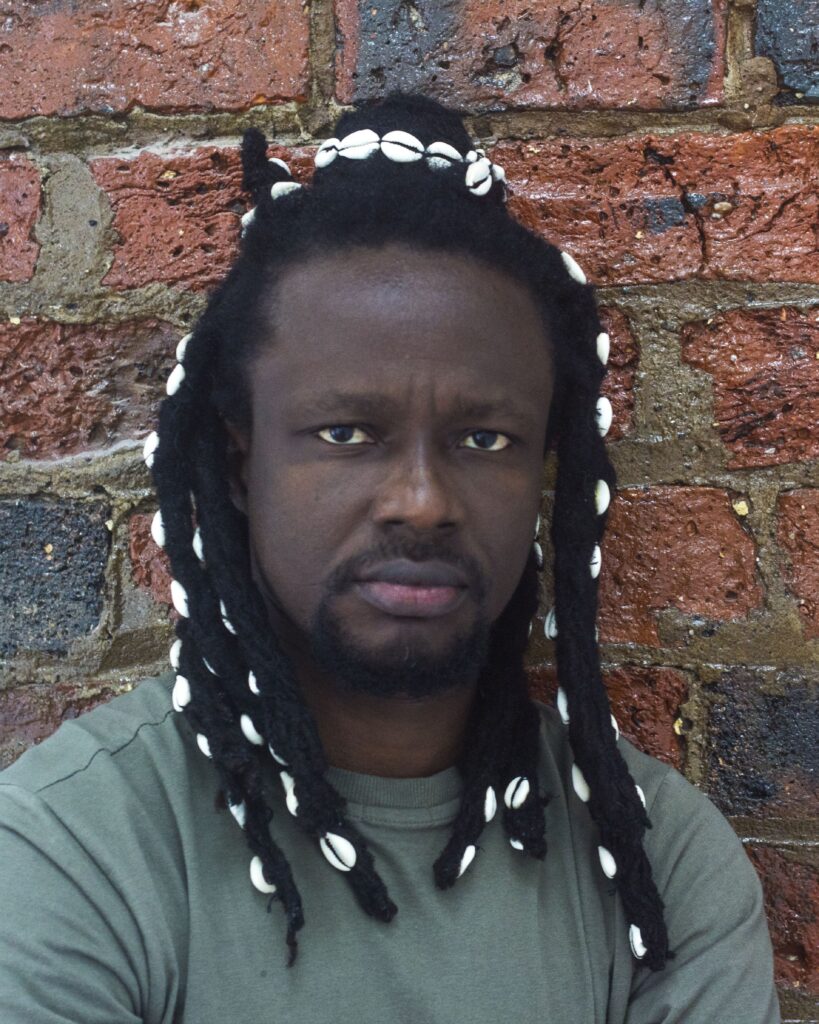
Ayọ̀ Akínwándé is a Nigerian-born visual artist, curator and writer whose multidisciplinary practice examines the intersections of people, power and politics. Working across painting, film, photography, installation, sound, sculpture and performance, he investigates the relationship between history and time, particularly how political authority, cultural memory, spiritual knowledge and systems of representation shape contemporary life.
Trained in architecture, Akínwándé approaches artistic production through an engagement with space, materiality and the social conditions of human experience. His ongoing project Archiving the Future (2016–present) examines political discourse, public memory and the circulation of information. More recent work, including Painting for the Gods, investigates Yorùbá spirituality, sacred ecology and spiritual provenance: the relationships, practices and knowledge that give cultural objects meaning beyond their histories of ownership and displacement. His performance The Palm (2024) addressed the ecological and cultural consequences of extractive practices.
His work has been presented internationally, including at Kunsthalle Wilhelmshaven, Germany; Edith-Russ-Haus, Oldenburg, Germany; the Brunei Gallery, SOAS, London; and the 13th Havana Biennial, Cuba. He co-curated the inaugural Lagos Biennial in 2017 and has participated in artistic residencies and collaborative projects across Africa, Europe and North America. His curatorial approach, which he describes as ‘curating on-the-go’, responds to the relationships between artworks, audiences and the spaces they inhabit.
Akínwándé is a recipient of the Prince Claus Seed Award (2021), the Edith-Russ-Haus Media Art Award (2020) and the Place Publique Prize, Fonderie Darling, Montréal (2019). Alongside his artistic and curatorial work, he writes critically on contemporary art, cultural institutions and the politics of representation, including essays published in Art Africa. His research and practice are informed by sustained exchanges with artists, communities and cultural knowledge holders.
He lives and works in the United Kingdom and Nigeria.